The headline number looks like a boom. In March 2026, the median sale price of a home in Bedford-Stuyvesant was $1.6M, up 33.5% compared to last year. If you stopped there, you would price offers accordingly and lose most of them.
The same monthly release shows the median price per square foot moved the other way. The median sale price per square foot in Bedford-Stuyvesant is $764, down 23.8% since last year. Homes are sitting longer, too: on average, homes in Bedford-Stuyvesant sell after 112 days on the market compared to 77 days last year, and there were 75 homes sold in March this year, down from 101 last year. Two numbers pointing in opposite directions is not a contradiction. It is a mix shift, and it is the most important thing to understand before you write an offer here.
The Mix Shift Behind The Headline
A rising median with a falling price per foot means the properties actually closing are bigger, not more expensive. Small condos and one-bedroom resales are stalling on the market. Larger renovated townhouses, often two- and three-family configurations, are the trades that clear. When those close, they drag the median up even as the underlying dollar-per-square-foot rate softens.
The broader index agrees. Zillow's home value index, which is designed to smooth mix effects rather than reflect what closed last month, puts the average Bedford-Stuyvesant home value is $953,646, down 4.2% over the past year. Read together, the two data points tell you the neighborhood is not appreciating in the way a $1.6M median implies. It is bifurcating.
Adjacent neighborhoods sit at different price points, which matters when you are running comps across a district line. In early 2026, one broker analysis pegged Clinton Hill ($860K), Bushwick ($1.2M), Crown Heights ($993K) as the nearest reference set. A 3,000-square-foot townhouse in Bed-Stuy and a 3,000-square-foot townhouse in Clinton Hill are not the same trade, and the median hides that. The right question is not "what is Bed-Stuy selling for," but "what is the specific building type I want doing, on the specific block I want it on."
The Landmark Line Is A Pricing Line
The variable that most reliably separates the fast-clearing renovated townhouses from the ones sitting 112 days is landmark status, because landmark status governs what a buyer can underwrite.
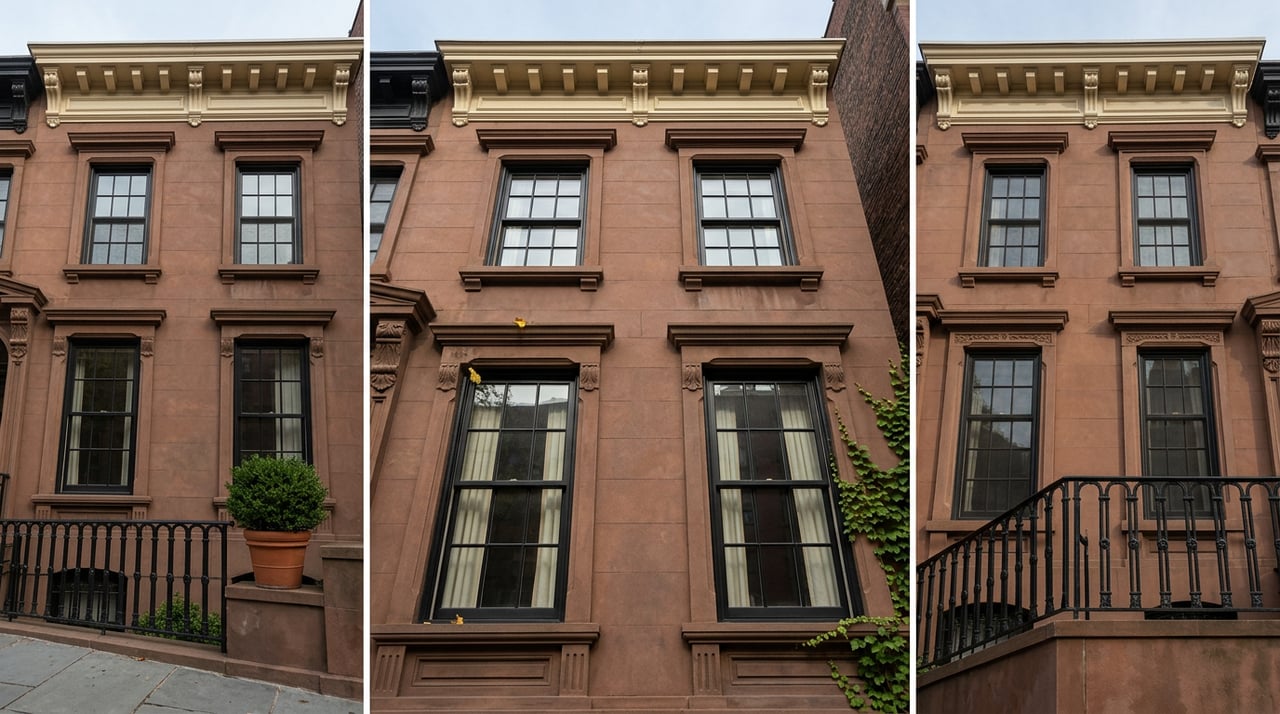
Bed-Stuy has four historic districts today. The most recent, the Willoughby-Hart Historic District, designated in 2024 in the wake of the demolition of the Jacob Dangler Mansion, added two intact 19th-century blocks to a preservation footprint that already included Stuyvesant Heights, the expanded Stuyvesant Heights district, and Bedford. The Willoughby-Hart designation captured more than 130 buildings that were erected between 1871 and the 1890s. If your target property sits inside any of those four boundaries, most exterior work and many rear-yard interventions need Landmarks Preservation Commission review before the Department of Buildings will act.
That review is not theoretical, and it is expanding. In February 2026, the Historic Districts Council named Stuyvesant North to its annual preservation list; a new organization, the Stuyvesant North Preservation Society, will work with HDC on championing further historic district designations in the area. If you are buying in the blocks north of Fulton and east of Bedford, you should assume more of that area could be designated within your hold period.
The practical read for a buyer is straightforward. Inside a historic district, the value uplift from a "gut renovation with rear extension and third-floor addition" is not a given. It is a permitted outcome that depends on what the LPC will approve on that specific block, in that specific architectural context.
Two LPC Files, Two Cost Curves
Two active Bed-Stuy projects show what "landmark-compatible" looks like on the ground, and both are worth studying before you sign a contract on a landmarked house.
The first is a proposal at 317 Jefferson Avenue, inside the Bedford Historic District, that came before the LPC in late February 2026. The New York City Landmarks Preservation Commission (LPC) is reviewing a proposal for modifications to 317 Jefferson Avenue, a three-story residential building in Bedford-Stuyvesant, Brooklyn. Designed by Gerald J. Caliendo Architects, the project consists of a vertical enlargement and rear yard extension to the existing rowhouse, along with its conversion into a two-family dwelling. The addition takes the form of a mansard roof as a third-floor vertical extension, set above the existing cornice line. This is the shape a "buy, expand, add rental unit" pro forma has to take inside a Bed-Stuy historic district: not a flat rooftop addition, but a mansard chosen because comparable additions already exist on Monroe, Marcy, and Putnam. Underwriting a rooftop cube here is underwriting a fight you will lose.
The second file is 87 MacDonough Street, inside Stuyvesant Heights, headquarters of the United Order of Tents. Restoration broke ground in October 2025. Records show the approved permit covers cleaning biological growth, repointing and replacing damaged brick, repairing the rubble stone foundation, and rebuilding parts of the rear facade and chimneys, all with matching materials. The permit says work will be done in phases, with this first phase prioritizing structural stabilization. That work is on a clock: the first phase will also help resolve a violation for failure to maintain the facade, which remains active and requires work to be completed by May 2026, with future phases covering roof, cornices, and stairs. Distressed landmarked properties are cheaper for a reason. The buyer inherits the violation, the phased-work discipline, and the cost of matching materials.
Between these two files sits most of the underwriting risk in Bed-Stuy right now. A clean mansard proposal is a two-year project with a defensible exit value. A facade-violation inheritance is a multi-phase capital plan whose scope the LPC, not the owner, defines.
Where Non-Landmarked FAR Still Prices In
Outside the district lines, the math looks different, and the market reflects it. Filings in February 2026 show permits have been filed for an eight-story mixed-use building at 717 Myrtle Ave. in the Bed-Stuy. The proposed 73-foot-tall building would total 16,746 square feet, including 12,413 square feet of residential space and 4,332 square feet of commercial space. Plans call for 10 residential units, likely condominiums, based on an average unit size of about 1,241 square feet. A 73-foot building with condo-scale floorplates is exactly the product type that cannot happen inside Willoughby-Hart or Bedford. Where zoning allows the envelope, developers are still building it.
For buyers, the practical filter is:
- Inside a historic district: underwrite the mansard, not the cube. Assume LPC review lead time on any facade or roofline change. Confirm any rear-extension precedent block-by-block, not district-wide.
- On the edge of a proposed district (Stuyvesant North today, potentially other blocks tomorrow): price in the possibility that renovation flexibility narrows during your hold.
- Outside the districts: FAR-driven condo pipeline is real, especially near the G train corridor. New supply changes what your resale looks like in five to seven years.
Reading A Bed-Stuy Comp In 2026
If you take one operational habit from all of this, make it separating landmarked comps from non-landmarked comps before you index anything against them.
- Pull the property's historic-district status first. The four current districts and the Willoughby-Hart boundary between Nostrand and Marcy are the lines that matter.
- Check for open LPC or DOB violations at the address. A property like 87 MacDonough carries obligations that price is only one input to.
- For any renovated comp above the $1.6M median, ask what the extension actually was. A mansard-and-rear-yard addition in the Bedford Historic District, like the 317 Jefferson filing, is a different comp than a full rooftop addition on a non-landmarked block.
- Weight days on market. In a market where the average stretched to 112 days, a house that traded in three weeks was priced at the market, not above it.
The 33.5% year-over-year median is real. So is the 23.8% drop in price per foot. Both statements describe Bed-Stuy in the same month. Reconciling them is the entire job.
FAQ
Does landmark status hurt resale value? Not on its own. Landmarking usually protects the architectural character that buyers pay a premium for on blocks like Willoughby-Hart. It constrains the type of renovation a buyer can execute, which is why the pricing question is really a renovation-scope question.
Is now a buying opportunity because days on market are up? Longer marketing times give buyers negotiating room on specific listings, particularly smaller units and unrenovated houses. It does not mean every seller has moved. Renovated two- and three-family townhouses continue to clear at the top of the range.
How is the district boundary drawn on my block? The LPC publishes maps for Stuyvesant Heights, the expanded district, Bedford, and Willoughby-Hart. The line can run mid-block, so an address one door down from a landmarked house is not automatically landmarked itself. Confirm before you write a scope of work into your offer.
If you are underwriting a Bed-Stuy townhouse this quarter and want a second read on the block, the landmark file, and what the comps actually tell you, Brooklyn Brownstone Sales offers a complimentary, no-pressure market consultation.