A shore seller who priced a house at $2,001,000 last summer and closed this spring didn't pay 2% on the top thousand dollars. They paid 2% on the entire two million. That single sentence is the whole story of what changed in New Jersey's transfer tax code, and it is the reason pricing a Spring Lake or Bay Head home in 2026 requires a level of tier discipline that most listing conversations still skip.
The overhaul that took effect July 10, 2025 gets described in most coverage as a "shift from buyer to seller" and a "graduated rate structure." Both are accurate. Neither captures why the change hits the Monmouth and Ocean County shore harder than almost any other slice of the New Jersey market, or why a $20,000 asking-price decision now routinely swings net proceeds by five figures.
The Rate Card Is A Staircase Of Cliffs
Bill S4666/A5804, signed by Governor Murphy on June 30, 2025, did two things at once. It moved the payment obligation from buyer to seller, and it replaced the flat 1% "mansion tax" with a tiered Graduated Percent Fee that applies to every dollar of consideration, not just the dollars above each threshold.
| Sale Price | GPF Rate | Fee At Bottom Of Tier |
|---|---|---|
| Over $1,000,000 to $2,000,000 | 1.0% | $10,000 to $20,000 |
| Over $2,000,000 to $2,500,000 | 2.0% | $40,000+ |
| Over $2,500,000 to $3,000,000 | 2.5% | $62,500+ |
| Over $3,000,000 to $3,500,000 | 3.0% | $90,000+ |
| Over $3,500,000 | 3.5% | $122,500+ |
The critical structural detail is that the rate applies to the total consideration stated in the deed, not the amount above the threshold. A property that trades at $2,000,001 owes the state $40,020 in GPF. The same property at $1,999,000 owes $19,990. Twenty dollars of price generates twenty thousand dollars of tax. This is what "cliff" means in the arithmetic sense, and every shore listing that lives between $1.9M and $3.6M is standing next to one.
Why The Shore Sits On Top Of These Cliffs
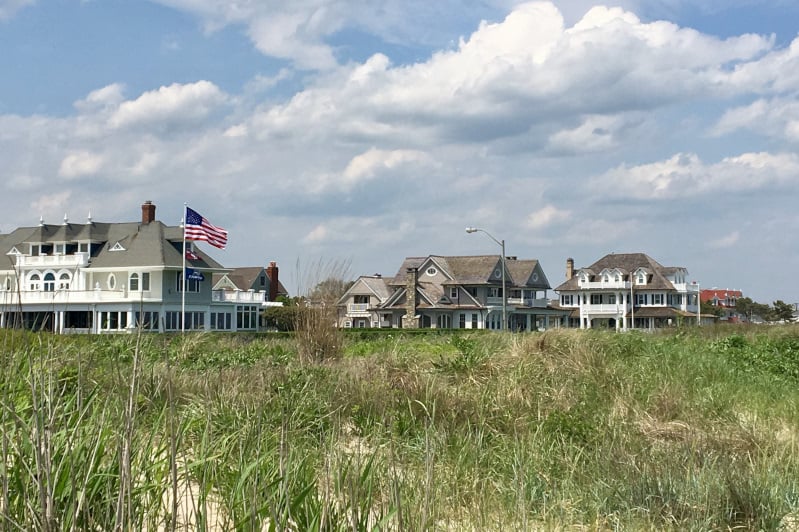
Statewide, the new rate schedule was projected to touch only the top 2% to 3% of transactions. In the shore towns Brooklyn Brownstone Sales works, that share runs materially higher. Zillow's home value index for Spring Lake read roughly $1.49 million at the end of May 2026, up about 13% year over year, and Spring Lake's transacted median has floated near and often above the $2M line for years. Bay Head, Mantoloking, Sea Girt, and Rumson routinely clear $2.5M for a full-block-to-beach or waterfront position. The typical primary-market home in these towns is not comfortably inside a tier. It is sitting on the seam.
A residential sale in Rumson listed at $2.49M received an offer at $2.51M. That $20,000 bump pushed the sale into the 2.5% bracket and added more than $12,000 to the seller's tax bill, because the higher rate applied to the entire $2.51M rather than the $10,000 of overage.
That kind of arithmetic is why the pricing conversation on a shore listing now begins with a tier map, not a comp set.
The Pricing Decision Inside The Tier
Under the old regime, a seller running an offer against a slightly higher one could evaluate the two on almost purely economic terms. The buyer paid the 1% fee, and the seller's proceeds moved cleanly with the price. That balance is gone. When a seller receives competing offers, three scenarios now sit in front of them where one used to:
- Two offers on the same side of a cliff. The higher offer is straightforwardly better. Tier math is neutral.
- Two offers straddling a cliff. The higher offer may net less. On a $2.5M-adjacent listing, a $2,490,000 offer nets more than a $2,510,000 offer once the GPF differential is added to the standard Realty Transfer Fee the seller already pays on top of the GPF.
- A ceiling-limited offer at the tier boundary. Structuring escalation caps and price-reduction contingencies to stop the number one dollar short of a cliff becomes a legitimate negotiation tool. It also has to survive appraisal and the buyer's own math.
Sellers who ignore this and simply take the top dollar can leave real money on the table. Sellers who overcorrect and refuse a strong offer to save a tier can lose the deal entirely. The right answer requires modeling the net at each candidate price, which is underwriting work, not intuition.
The CITT Parallel Catches LLC-Owned Shore Homes
A meaningful share of second-home purchases on the shore are held in single-purpose LLCs, both for privacy and for eventual estate work. The 2025 legislation amended the Controlling Interest Transfer Tax to mirror the mansion tax schedule and, importantly, shifted CITT liability to the seller of the interest as well. A transfer of the controlling interest in an LLC whose sole asset is a $3.1M Bay Head home now runs through the same 3% tier a direct deed transfer would, applied to the full consideration or equalized assessed value. The workaround that used to make an LLC sale meaningfully cheaper than a deed sale for the buyer no longer exists on the closing statement, and it has migrated onto the seller's side of the ledger.
For owners who bought through an LLC in 2018–2022 planning to eventually transfer the entity rather than the property, that base assumption needs a fresh look before listing.
Mixed-Use And The April 2026 Tax Court Signal
Some shore properties combine a residence with a rental cottage, a storefront, or a small marina slip. Under the statute, the GPF applies to Class 2 residential, Class 4A commercial, and Class 3A farmland containing a residential structure. Classification is set by the municipal tax assessor, and a property whose classification is arguable can carry very different tax exposure depending on how the assessor and the deed line up at recording.
The New Jersey Tax Court issued a decision on April 27, 2026 that adopted a predominant-use analysis for mixed-use properties in the mansion tax context. The practical effect is that a property with meaningful non-qualifying use may be re-characterized, and small differences in how the use is documented can produce meaningful tax differences at closing. Any shore owner sitting on a property with a legal accessory unit, a nonconforming commercial space, or a garage that has become a short-term rental should have the classification reviewed before a listing goes live, not after a signed contract exposes the assumption.
Why Buyers Still Care, Even Though They Don't Pay
Buyer-side agents sometimes describe the change as pure relief for buyers. The 1% they used to owe at closing is gone, and on paper the closing cost line is smaller. In shore markets that framing understates how the tax has moved into price rather than out of it.
A seller who models the GPF into the reserve price will surface it in the ask. Buyers who have watched shore inventory tighten know this. What actually shifted is negotiation leverage at the tier boundaries. A buyer whose top number sits just above a cliff can credibly ask the seller to accept a price just below it, splitting the tax savings, because both sides understand that the seller's net at $2,490,000 may exceed the seller's net at $2,540,000. That is a genuinely new conversation, and the buyers who prepare for it will win listings that used to sell on emotion alone.
The grace-period refund window, which allowed sellers under contracts fully executed before July 10, 2025 to claim back amounts paid in excess of 1% if the deed was recorded by November 15, 2025, has closed. Everything now closing on the shore closes under the full schedule.
What This Changes About Listing Prep
The old listing prep checklist for a shore home in this price band was familiar: staging, photography, punch list, comparable analysis, launch price. The 2026 version adds three items that used to be afterthoughts. First, a tier map that overlays likely offer ranges on the GPF schedule and identifies which cliffs the property sits closest to. Second, a fresh look at property classification if any part of the property is non-residential in use. Third, an ownership review for LLC-held homes to test whether an entity transfer still makes sense compared with a straight deed.
None of that changes the underlying appeal of a Bay Head cedar on a wide lot or a Spring Lake block near the boardwalk. It changes what the seller keeps when the deal closes, which is the number that actually matters when someone is deciding whether to sell at all.
If you are considering a shore listing in 2026 or evaluating an offer that lands near one of these tier boundaries, Brooklyn Brownstone Sales will model the net-proceeds outcome at every candidate price and walk you through the tier decision with the same underwriting discipline we bring to a townhouse valuation. Schedule a complimentary, no-pressure market consultation to see the math on your specific address before it becomes a closing-table surprise.