Commentary
July 23, 2026
By Steven Segretta
One of the more difficult conversations I have with buyers isn't whether a home is worth the asking price.
It's whether it's worth what it may actually take to buy.
In today's competitive market, those are often two very different numbers.
Most buyers tell me they don't want to overpay. That's a perfectly rational objective. But before we can answer that question, we first have to ask a more fundamental one:
What does "overpaying" actually mean?
Imagine a home that appears to be worth $2,000,000 based on recent comparable sales.
Five qualified buyers compete for it.
One ultimately pays $2,150,000.
Did they overpay?
The honest answer is:
Maybe.
Perhaps they paid more than the historical comparable sales would suggest. Or perhaps the market was revealing something those sales hadn't yet captured. Maybe inventory had tightened. Maybe buyer demand had accelerated. Or perhaps the home offered qualities that made it unusually difficult to replace.
It's also possible that competitive emotion simply took over.
Distinguishing between those possibilities is one of the most difficult, and most important, parts of representing buyers.
Comparable Sales Are the Beginning, Not the End
For much of the past six years, neighborhoods across Brownstone Brooklyn have operated in a strong seller's market. Multiple-offer situations have become the rule rather than the exception, forcing buyers to make decisions in an environment where yesterday's sales don't always tell the entire story.
Comparable sales remain the foundation of every valuation.
But they are only one piece of the puzzle.
Understanding where a property may ultimately trade requires far more than reviewing comparable sales. It requires data, analytical tools, relationships, experience, and judgment.
In evaluating competitive situations, I routinely analyze factors such as comparable sales, online activity, open house traffic, agent-to-agent inquiries, competing offers, pricing strategy, contract timing, inventory levels, and broader supply-and-demand trends.
Over time, one conclusion has become increasingly clear.
Winning isn't determined solely by comparable value.
It's determined by the interaction between value, competition, supply, demand, and market momentum.
When the Market Speaks
Recently, I represented buyers interested in a two-bedroom apartment with an unusually large outdoor space—something genuinely rare in the Brooklyn condominium and cooperative market.
Initially, they assumed they might be able to purchase the apartment somewhere near its asking price. Based on the comparable sales, that seemed like a reasonable expectation.
Then more than 160 groups attended the first open house.
At that moment, the conversation changed completely.
The question was no longer:
"What is this home worth?"
It became:
"What will today's market require to buy it?"
The listing strategy was almost certainly designed to maximize competition, allowing buyers—not the asking price—to determine the property's eventual value.
Based on the activity I was observing, I believed the apartment would likely sell at least $200,000 above asking.
Helping buyers recognize that shift is one of the most valuable ways I can advise them.
It's not about encouraging buyers to overbid.
It's about recognizing when today's competitive market no longer resembles the market reflected in yesterday's comparable sales.
Thinking About Value Differently
Before entering residential real estate, I spent more than thirty years analyzing value in debt and equity markets.
Financial markets are highly liquid. Prices adjust continuously as buyers and sellers process new information.
Housing markets are different.
Every property is unique.
Transactions are relatively infrequent.
Information is imperfect.
And unlike financial assets, homes carry enormous emotional significance.
That requires a different way of thinking about value.
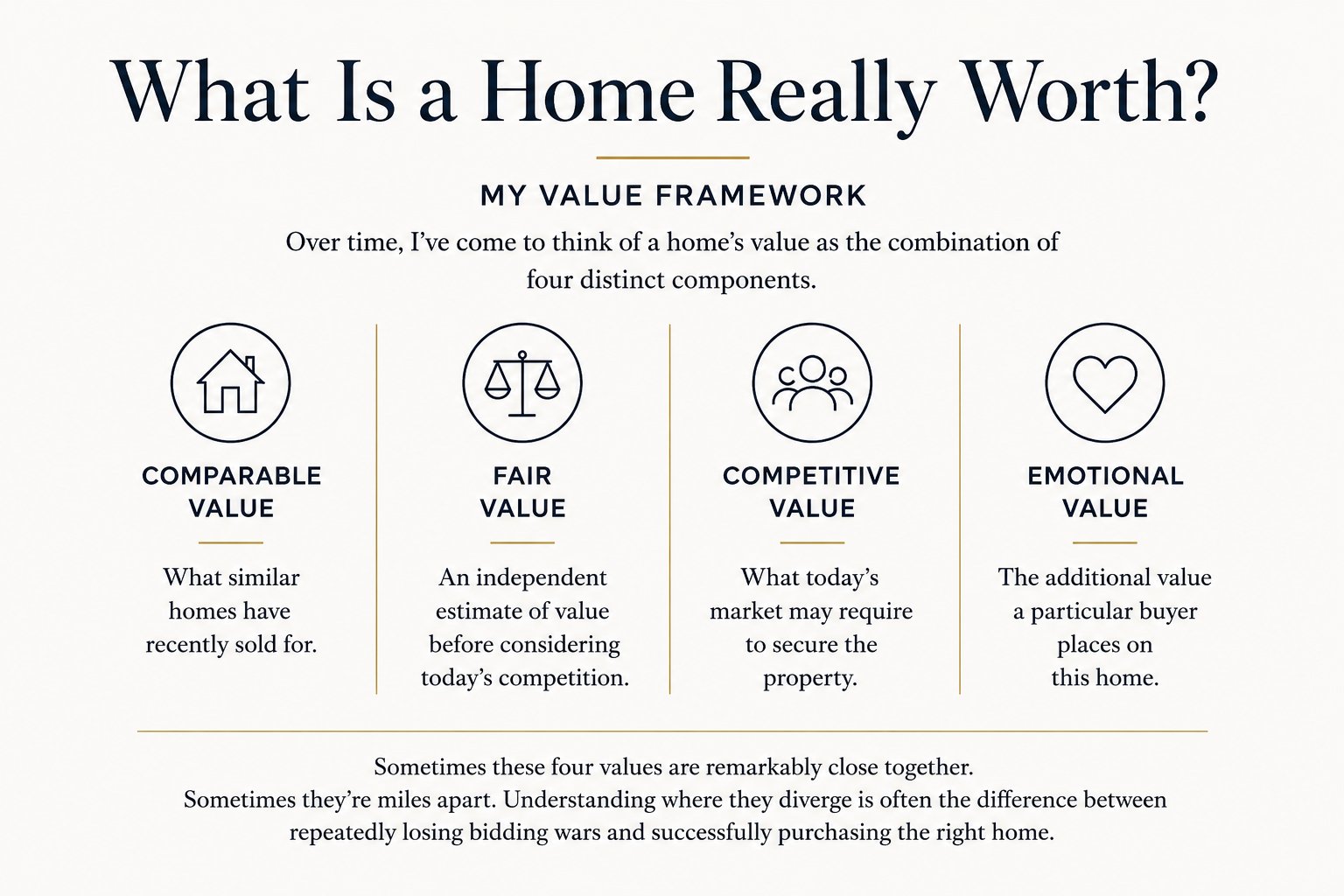
Over time, I've come to think of a home's value as the combination of four distinct components.
Comparable Value
What similar homes have recently sold for.
Fair Value
My independent estimate of what a property is worth after considering its condition, location, layout, and available alternatives—before considering today's competitive environment.
Competitive Value
The price today's market may realistically require to have a meaningful chance of securing the property.
Emotional Value
The additional value a particular buyer places on a home because it uniquely fits their lifestyle, priorities, or future plans.
Sometimes these four values are remarkably close together.
Sometimes they're miles apart.
Understanding where they diverge is often the difference between repeatedly losing bidding wars and successfully purchasing the right home.
Looking Backward vs. Looking Forward
Many buyers believe they're negotiating with the seller.
In reality, they're usually competing against other buyers—each bringing different financial resources, priorities, risk tolerances, and emotional motivations to the table.
Comparable sales tell us where the market has been.
Competition often tells us where it's going.
Comparable sales are, by definition, backward-looking.
Buyers, however, must make decisions in today's market—not yesterday's.
That doesn't mean buyers should abandon discipline. In fact, the opposite is true.
Sometimes the right decision is to walk away.
Sometimes the market simply demands more than a property is worth to a particular buyer.
But I've also seen buyers repeatedly lose homes they would have happily owned for the next fifteen years—not because they misunderstood the property's value, but because they misunderstood the market they were competing in.
The Balance
My role isn't simply to estimate value.
It's to help buyers understand the difference between paying too much and paying enough to have a realistic opportunity to succeed.
Sometimes that means encouraging a buyer to walk away.
Sometimes it means encouraging them to compete more aggressively than they initially imagined.
The challenge is knowing the difference.
Helping clients find that balance—between disciplined analysis and competitive reality—is one of the most challenging and rewarding parts of representing buyers.