
A Market Where Details Matter
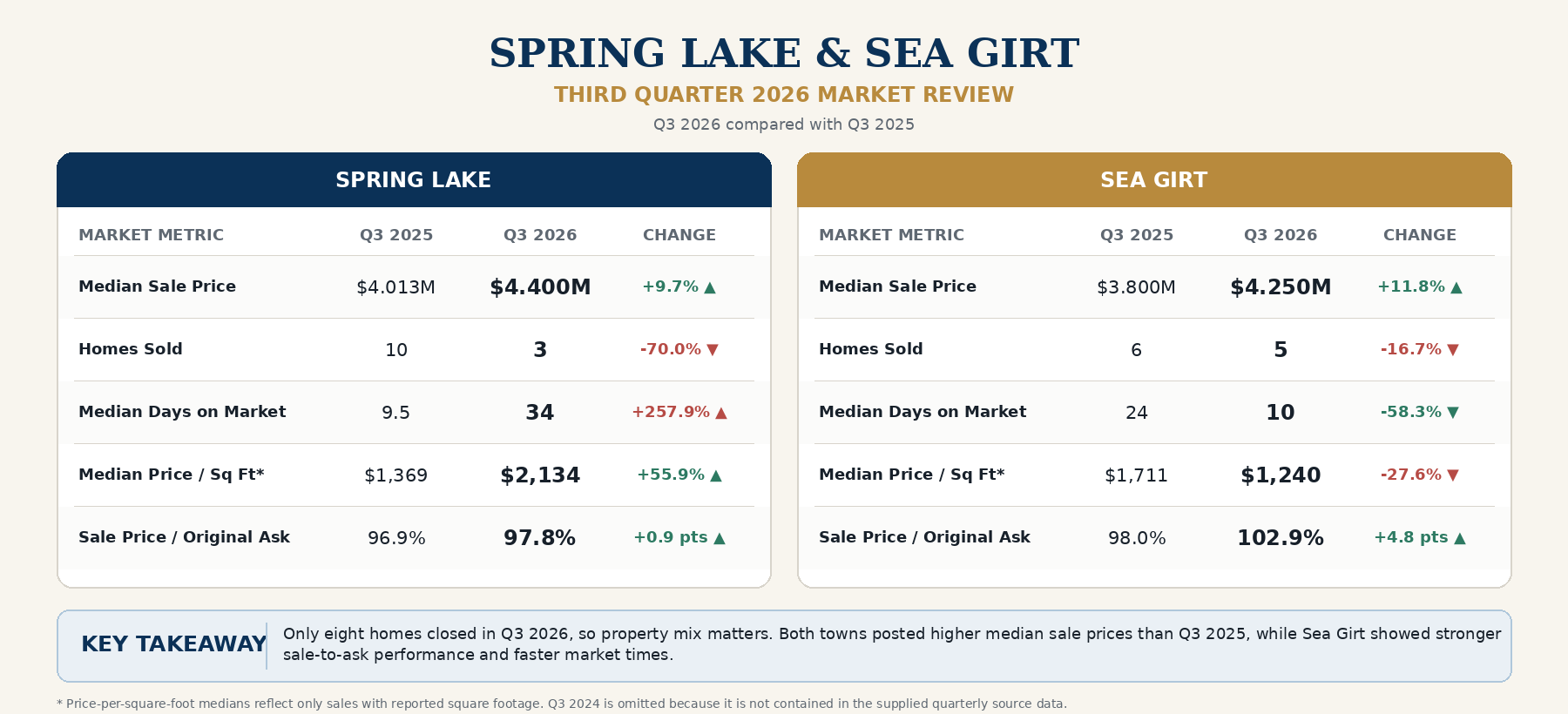
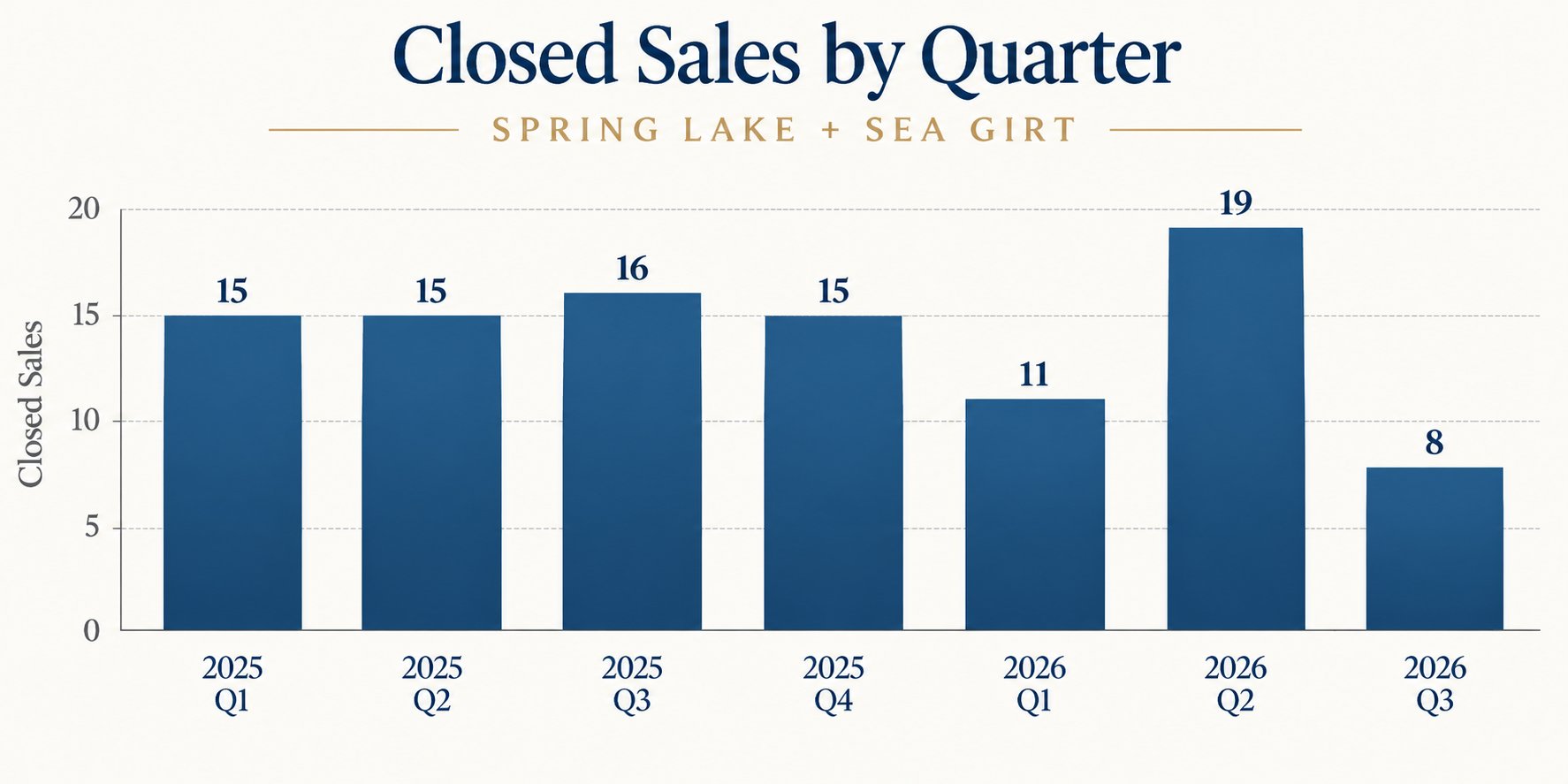
Eight homes closed in Spring Lake and Sea Girt during the third quarter, representing $38.55 million in sales. The combined median sale price was $4.325 million. While those numbers describe the quarter, they don't fully explain it.
Spring Lake and Sea Girt are small, highly differentiated markets, where home values can be shaped by a variety of factors, including proximity to the ocean, lot size and width, zoning and buildable potential, condition, architectural quality, and the competing inventory available at the time a property reaches the market.
With only eight closings during the quarter, differences among the properties themselves can have an outsized effect on the statistics. The mix of larger and smaller homes, renovated properties and redevelopment opportunities, or conventional and oversized lots can move median and average prices sharply without implying a comparable change in the underlying value of any particular home.
Looking beyond a single quarter helps separate those shifts in property mix from broader market patterns. When the lens is widened to include sales activity since January 2025, one thing becomes increasingly apparent: scarcity is a significant driver of value, but scarcity takes different forms at different points in the market.
At the lower end, it can mean a relatively accessible entry point into a coveted location. At the upper end, it can mean control of a wide, near-ocean lot with a development opportunity that simply can't be replicated on a conventional property.
The key question is not simply, 'What did the average do?' It is: what was scarce about the properties buyers chose to pay for?
Q3 2026 at a Glance
What Is Driving Value at the Shore?
Towns along the shore are not homogeneous markets. The sales show buyers evaluating a bundle of attributes rather than a single metric. Price matters, but so do land, location, zoning, condition, redevelopment potential and timing. Often, the strongest results occur when several of those factors combine to create something buyers perceive as difficult to replace.
1 | Competition Was Strongest at the More Accessible End of the Market
One of the more interesting patterns in the 2026 sales was the strength of buyer competition for properties priced toward the lower end of the Spring Lake and Sea Girt market. Among closings through the third quarter, homes selling below $3.5 million showed the strongest overall sale-to-original-ask performance.
That doesn't necessarily mean buyers preferred lower-priced homes. Rather, there are relatively few opportunities to purchase in Spring Lake or Sea Girt at these price levels, and those that combine an accessible price with a desirable location can attract significant interest, even when the property itself involves meaningful compromises.
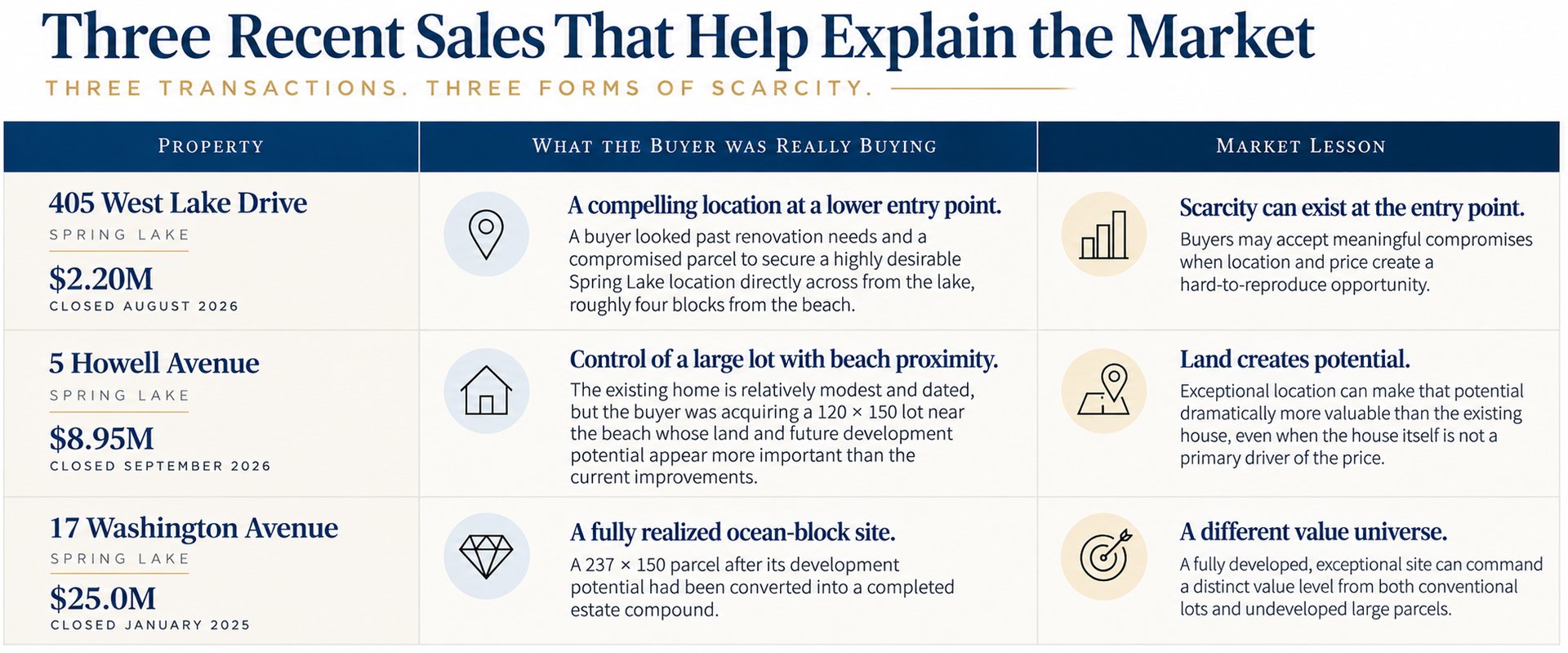
405 West Lake Drive provides a good example. The property required renovation and sits on an irregular site with a rear driveway easement and limited redevelopment potential. Yet it offered a location directly across from Spring Lake, roughly four blocks from the beach, at an original asking price of $1.70 million.
It ultimately sold for $2.20 million... $500,000, or approximately 29%, above its asking price.
The result suggests that buyers weren't simply competing for the house. They were competing for an unusually affordable opportunity to own in a desirable Spring Lake location.
2 | Land Creates the Potential. Location Determines the Upside.
One of the clearest patterns in recent sales is the concentration of larger lots among the market's highest-priced properties. Seven of the eight highest-priced 2026 sales through the third quarter with reported lot dimensions were on lots wider than 50 feet.
But lot size alone does not explain value. A number of properties on 100-foot-or-wider lots have sold below $6 million despite substantial redevelopment potential. That is not inconsistent with the value of the land. A buyer contemplating a rebuild still has to account for demolition, architectural and engineering work, construction, landscaping and amenities, carrying costs, time and execution risk. A speculative developer also needs to leave room for profit.
Just as importantly, the value of the future home depends on where the land is located and what zoning and lot configuration actually allow. Additional frontage is not valuable merely because it provides more yard. In the right location and zoning district, it can support a materially different home, greater separation from neighbors, more substantial outdoor amenities and a higher ultimate property value.
Land creates the development opportunity. Location and zoning determine how valuable that opportunity can become and development costs determine how much of that future value can be paid for today.
Why Large Lots Can Still Sell Below $6 Million
Several transactions help illustrate the distinction between today's land value and the potential value of a completed property. 216 Boston Boulevard in Sea Girt sold for $4.50 million on a 100 x 150 lot and was marketed as an opportunity to renovate or build new. 208 Ludlow Avenue in Spring Lake sold for $4.45 million on a 100 x 150 lot and was likewise positioned as a custom-home opportunity. 105 Saint Clair Avenue sold for $5.50 million on a 100 x 150 lot just one block from the beach and was marketed for renovation or rebuilding.
These prices do not mean the redevelopment potential is unimportant. They show that potential is future value, not present value. The buyer must still spend the money, wait through design and construction, assume execution risk and, in the case of a developer, earn a return on that capital.
They also show why nominal lot size is not enough. A 100 x 150 lot farther from the ocean may not support the same finished-home value as a similarly sized site close to the beach. An irregular or encumbered parcel may contain substantial land area while offering less usable development flexibility. What ultimately matters is the development envelope and the value the location can support.
Buying the Site, Not Just the House
The $8.95 million sale of 5 Howell Avenue provides a particularly useful example. The existing home is relatively modest and dated for a property at this price level. On a conventional price-per-square-foot analysis, the transaction can therefore look difficult to explain.
But that may be the wrong way to look at it. The property occupies a 120 x 150 lot essentially at the beach. A buyer contemplating a major renovation or rebuild is not simply purchasing the existing house. The buyer is gaining control of an unusually large lot in a location where comparable sites are extremely difficult to reproduce.
For a wealthy end user planning a long-term custom home, those economics can differ materially from a conventional developer's. The end user does not necessarily require an immediate development profit. The objective may be to create exactly the home, outdoor space and setting desired on a property that may not become available again for years.
A speculative developer faces a more demanding calculation. At an $8.95 million acquisition price, the eventual resale value would need to absorb the land cost, demolition, construction and soft costs, financing and carrying costs, selling expenses and a development profit. The supplied market data does not by itself establish that 5 Howell works as a speculative development project; that would require a property-specific zoning and residual-value analysis.
What the sale does demonstrate is that the market placed substantial value on the combination of land and near-ocean location rather than simply on the existing improvements.
When Price per Square Foot Stops Working
Price per square foot remains useful when comparing similar finished homes on similar sites. It becomes considerably less useful when the underlying land represents a large portion of the property's value.
At 5 Howell, dividing the $8.95 million purchase price by the square footage of the existing house implicitly assigns the entire purchase price to the current structure. That is not what the transaction appears to represent.
The more valuable the site and its unrealized development potential, the less meaningful the square footage of the existing house becomes as the denominator for valuation.
A Conventional Lot Appears to Have a Different Value Envelope
The 2025-26 sales also support the idea that conventional Zone 2 lots operate within a different value range. Exceptional finished homes on those lots have generally topped out in the upper-$5 million to low-$6 million range. Examples include 2009 Ocean Avenue at $6.475 million, 11 Union Avenue at $6.20 million, 103 Seaside Place at $6.00 million, 105 Philadelphia Boulevard at $5.80 million, 107 Philadelphia Boulevard at $5.75 million and 418 Monmouth Avenue at $5.743 million.
This should not be described as a hard $6 million ceiling. The exceptions are instructive: the properties moving above that level on conventional-width lots tend to have exceptional ocean proximity, views or other scarce characteristics. The broader point is that a smaller site can constrain the ultimate development envelope in a way that larger sites may not.
From Potential to a Fully Realized Site
The January 2025 sale of 17 Washington Avenue for $25 million provides the other end of the spectrum. Its extraordinary 237 x 150 ocean-block parcel had already been developed into a major estate compound, with a 2023 main house, guest house, pool and extensive amenities.
In that transaction, the buyer was not purchasing unrealized development potential. Much of that potential had already been converted into a finished product. The improvements clearly contribute enormous value, but the site itself allows a scale of home, privacy and amenities that a conventional parcel cannot reproduce.
Viewed together, large-lot redevelopment opportunities, 5 Howell and 17 Washington illustrate a continuum: an under-improved site contains potential; realizing that potential requires capital, time and risk; and a fully developed exceptional site can occupy an entirely different value category.
Location Magnifies the Value of Land
The tax maps reinforce the physical pattern familiar to local owners: lot pattern and proximity to the ocean are intertwined. In Spring Lake, the larger-lot areas closer to the ocean can provide a materially different development opportunity from the more conventional lots farther west. Sea Girt similarly contains distinct location and lot patterns.
That is why a mechanical 'dollars per block from the beach' calculation would be misleading. 5 Howell combines an unusually large site with exceptional beach proximity. 314 Brooklyn Boulevard sold for $7.20 million on a 75 x 150 lot after being offered at $6.20 million. 405 West Lake is farther from the ocean and physically compromised, but its lake setting and low entry price created a different kind of scarcity.
Location does more than add a premium to land. It helps determine the value of what that land can ultimately become.
The Shore Market Begins Well Before Summer
Timing is another reason quarterly closing statistics can be deceptive. A home that closes in July or September may have found its buyer in the spring. Several of 2026's most competitive transactions were introduced well before the traditional summer season.
For properties that ultimately closed through Q3 2026, spring launches had the shortest median market time in the supplied data. The comparison should not be treated as causal because property mix differs by season and older carryover listings can distort later cohorts. The useful conclusion is simpler: meaningful Shore demand does not wait for Memorial Day.
For sellers, the implication is not 'always list early.' It is that buyers hoping to enjoy a home for the coming summer may be highly engaged in winter and spring, and waiting until summer can mean missing part of that demand.
Three Sales That Tell the Story
What Is Available Now?
The October 9 activity snapshot shows 21 active listings and 8 pending listings across the two towns. Spring Lake has 14 active listings, ranging from approximately $3.40 million to $15.0 million, with a median asking price of about $5.65 million. Sea Girt has 7 active listings, ranging from approximately $1.45 million to $7.495 million, with a median asking price just under $5.0 million.
That inventory matters because closed sales are backward-looking. Today's seller is competing against the homes buyers can choose now, and today's buyer is deciding whether a particular property's combination of location, land, condition and price is compelling relative to those alternatives.
What the Third Quarter Is Telling Us
Scarcity exists at both ends of the market. An unusually accessible entry point can attract competition just as surely as an oversized near-ocean parcel.
Land creates potential, not automatic value. The value of a large parcel depends on location, zoning, configuration, development costs and what the finished property can ultimately support.
Price per square foot needs context. It remains useful for comparable finished homes on similar sites, but can be misleading when land and redevelopment potential dominate the economics.
The market is active before summer. Buyer decisions are often made in winter and spring even when the closing appears in a later quarter.
Property-specific analysis matters more than the headline median. Small transaction counts and wide variation in sites and homes make broad averages a starting point rather than a valuation conclusion.
Looking Ahead
The third quarter was not defined by a single direction in prices. It was defined by selectivity. Buyers have shown a willingness to pay aggressively when a property offers something difficult to reproduce - a large site, exceptional beach proximity, a finished product, redevelopment potential, or an unusually attractive entry point.
For homeowners, the most useful question is therefore not simply, 'What is the median price in Spring Lake or Sea Girt?' It is where a particular property sits within this hierarchy of scarcity, development potential and current competition.
Comparable sales remain the starting point. But in a market where the land beneath an older house can sometimes matter more than the house itself, understanding zoning, buildability, location and the economics of redevelopment can be just as important as understanding the last sale on the block.
Steven Segretta
Sales Associate | Berkshire Hathaway HomeServices Fox & Roach
Spring Lake, New Jersey
Data note: Analysis is based on the supplied MLS-derived activity and sales workbooks, covering closed sales from January 2025 through September 2026 and active/pending inventory as of October 9, 2026. Property remarks and local context are used qualitatively. The discussion of development potential is conceptual; the supplied data does not independently establish allowable buildable area or a specific residual land value for any property.